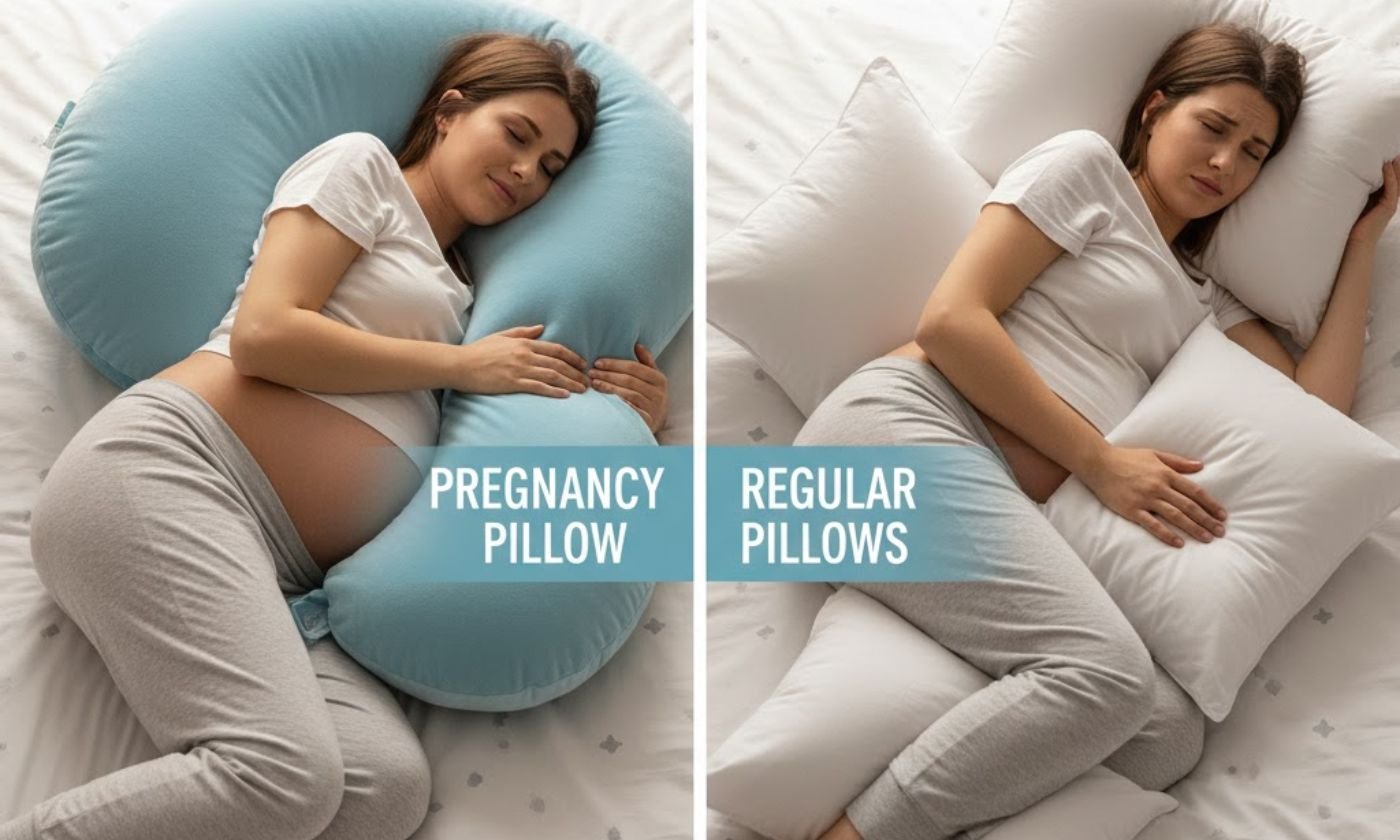
pregnancy pillow vs regular pillow side-by-side comparison for pregnant women’s sleep support

Pregnancy Pillow vs Regular Pillow: What’s the Difference?

Choosing the right pillow might seem like a small detail, but when you are pregnant, every little comfort counts. The debate of pregnancy pillow vs regular pillow is not just about curves or size, it’s about support, alignment, safety, and decent sleep. Many expecting mothers struggle with discomfort, backaches, and disrupted sleep as the body changes. A good pillow can make a significant difference. In this article, we will explore pregnancy pillow vs regular pillow in depth, compare their pros and cons, and help you choose which is best for you in different stages.

Pregnancy pillow vs regular pillow

The most visible difference between a pregnancy pillow and a regular pillow lies in design. A pregnancy pillow tends to be long, curved, and contoured, offering support along multiple points — belly, back, hips, knees. It might be full-body or wedge-style. In contrast, a regular pillow is usually rectangular, flat (or with some loft), and intended mainly to support your head and neck, leaving the rest of the body free.

Thus, structurally, pregnancy pillows are built to cradle multiple parts of the body concurrently, whereas regular pillows focus on just one region: head/neck. That sets the stage for many of the ensuing differences.

Purpose and use case for a pregnancy pillow

A pregnancy pillow is specifically designed to support a pregnant body. As your belly grows, your center of gravity shifts, and your spine, hips, and pelvis may experience greater strain. A pregnancy pillow aims to:

  • Support the baby bump so the abdomen isn’t pulling down

  • Align the spine and reduce back tension

  • Cushion between knees/hips to maintain a neutral hip alignment

  • Provide optional support for the upper back or shoulders

Typically, these pillows are most beneficial in the second and third trimesters, when size and weight begin to strain your usual sleeping posture. But many women find benefit even earlier, as a preemptive comfort measure.

Purpose and use case for a regular pillow

A regular pillow is built for everyday sleep use. It supports the head and neck, helping maintain alignment of the cervical spine. People choose regular pillows based on firmness (soft, medium, firm), fill (memory foam, down, synthetic), and shape (standard, queen, king). For individuals without special support needs, a good regular pillow can offer adequate comfort. The assumption is that your torso, hips, and back are already sufficiently supported by the mattress and your natural posture.

In non-pregnancy times, a well-matched regular pillow is often sufficient for restful sleep.

Support and alignment: spine, hips, belly

One of the strongest arguments for a pregnancy pillow is how it affects alignment. When pregnant, your lumbar region may lordose (curve inward) more, and your hips and pelvis shift. A regular pillow cannot help align the pelvis or relieve pressure between the thighs. Thus:

  • Pregnancy pillows often incorporate side support so you can sleep on your side, which is the recommended position (especially left side).

  • They maintain a neutral vertical alignment from head to hips.

  • By placing a cushion between knees, they prevent internal hip rotation and reduce strain.

In contrast, a regular pillow only supports the head; anything else must rely on mattress or body adaptation.

Types of pregnancy pillows

Pregnancy pillows come in several styles, each with pros and cons:

  • Full-body pillow / J-shaped: long pillow you wrap your body around.

  • C-shaped / U-shaped: supports both front and back simultaneously.

  • Wedge pillow: small triangular pillow to support belly or back.

  • Bolster / knee pillow: small cushion used between legs or under belly.

  • Inflatable or adjustable: you can change firmness or shape.

Each style addresses different preferences, some people prefer large wraparound pillows, others just a wedge under the bump.

Types of regular pillows

Regular pillows also come in various forms:

  • Standard / Queen / King sizes

  • Memory foam / shredded foam

  • Down / down alternative

  • Latex / natural fiber / polyester

  • Adjustable (removable fill)

Key is to match your sleeping style (side, back, tummy) with the right fill and firmness.

Materials: filling & cover

Materials affect comfort, durability, breathability:

  • Pregnancy pillows might use microbeads, polyfill, memory foam, or fiberfill

  • Covers often are cotton, jersey, bamboo, or polyester blends

  • Regular pillows follow the same material options

The right material can help regulate temperature and reduce pressure points.

Firmness and adjustability

A pregnancy pillow should be firm enough to provide support but not so hard that it’s uncomfortable. Many models allow adjustability, removable or added fill. Regular pillows also offer firmness options, but they seldom extend beyond head/neck support.

Size and footprint on the bed

Because pregnancy pillows are often large, they take up a lot of bed space. If you share a bed, the footprint might intrude on your partner’s side. Conversely, a regular pillow keeps to the head region and minimally impacts the bed footprint.

Breathability and cooling features

Pregnancy often causes you to feel hotter. Good pillows allow airflow via breathable covers, mesh panels, or cooling fabric. Both pregnancy and regular pillows benefit from good ventilation so you don’t overheat during sleep.

Safety and health considerations in pregnancy

During pregnancy, overheating or poor circulation should be avoided. Using a pillow that keeps you in proper position, avoids pressure on blood vessels, and uses safe materials is crucial. Always ensure there are no sharp edges, excessive firmness, or materials that cause allergies.

Impact on partner’s sleep

Because pregnancy pillows are bulky, your partner might feel squeezed or disadvantaged in bed. This must be considered in bed sharing. Sometimes couples use separate pillows or push the pregnancy pillow to one side.

Transition use postpartum

After birth, you might not need a huge support pillow. But some mothers still use parts of their pregnancy pillow (e.g. as nursing support or for positioning baby). Over time many revert back to a regular pillow.

Cost and durability

Pregnancy pillows tend to cost more than regular ones, because of their size and design. Durability depends on the fill quality and how well the cover protects it from wear and washing.

Ease of cleaning and maintenance

Large pillows are harder to clean; many have removable covers or partial zip designs. Regular pillows are easier to wash/dry or replace.

Portability and travel

Traveling with a massive U-shaped pregnancy pillow is impractical. Wedge pillows or smaller supports are more travel-friendly. Regular pillows are far easier to carry or pack.

User comfort and feedback

Many pregnant women report dramatic improvements in sleep comfort and pain reduction when using a pregnancy pillow, especially in late pregnancy. However, some find them unwieldy or uncomfortable initially. Comfort is subjective.

Who should avoid pregnancy pillows

If you have a very small bed, mobility constraints, or conditions that make moving with large pillows difficult, a pregnancy pillow might pose inconvenience. Also, some women feel excessive bulk is bothersome.

Combining both types

In some cases, women use a pregnancy pillow for body support plus a regular pillow for head/neck support. This hybrid approach can bring the best of both worlds.

How to choose the right pillow for you

Here’s a checklist:

  • Your sleeping position (side, back, stomach)

  • Bed size

  • Materials and breathability

  • Adjustability

  • Partner’s comfort

  • Ease of cleaning

  • Budget

Compare models and test if possible.

Best brands and product recommendations

I won’t push a specific product, but some trusted brands offer reliable pregnancy pillows. Look for ones with good user reviews, breathable covers, and strong return policies.

Tips for better sleep posture in pregnancy

  • Sleep on your left side

  • Use pillows between knees

  • Elevate upper body slightly if you have heartburn

  • Keep pelvis aligned

  • Avoid lying flat on your back after mid-pregnancy

Common myths and misconceptions

  • Myth: pregnancy pillow is only for late term (false – can help earlier)

  • Myth: regular pillows are enough always (not always true)

  • Myth: more expensive always means better (not necessarily)

pregnancy pillow vs regular pillow: final verdict

There is no one-size-fits-all. In early pregnancy, a regular pillow might suffice. But as your body changes, a pregnancy pillow often provides better support, comfort, and alignment. Many women benefit most from using both in tandem. Your ideal choice depends on your body, bed size, budget, and preferences.

FAQs

What is the best type of pillow to use in pregnancy?
It depends on your needs, bed size, and sleeping posture. Many prefer full-body or U-shaped pillows for all-around support, but a wedge or bolster may suffice for some.

Can I use a regular pillow instead of a pregnancy pillow?
Yes—especially in early pregnancy or if your discomfort is mild—but you’ll miss out on support for hips, back, and belly that pregnancy pillows are designed to give.

When should I stop using a pregnancy pillow?
You can continue as long as it gives comfort. Postpartum, you might switch back gradually or repurpose it for nursing support.

Does a pregnancy pillow help with back pain?
Yes, many users report reduced back pain because pregnancy pillows improve spinal alignment and relieve pressure. But results vary.

Will my partner be disturbed by a pregnancy pillow?
Possibly. The bulk can encroach on their side. You may need to reposition or compromise using slimmer pillows or offset placement.

How do I clean a pregnancy pillow?
Most come with removable covers. Wash covers as instructed (often machine wash). For the pillow itself, use spot cleaning or follow manufacturer’s recommendations, full washing might be impractical.

Conclusion

Choosing between a pregnancy pillow vs regular pillow is not just about shape; it’s about comfort, health, and quality of sleep during a critical time. While regular pillows offer simplicity and familiarity, pregnancy pillows are engineered to adapt to a changing body, offering tailored support to belly, back, hips, and more. The best approach may well be a hybrid, using both in harmony. Evaluate your space, sleeping style, and needs. Try before you commit, and prioritize ease of use and cleanability. Rest well, and may your nights be calmer, safer, and more restful through this special journey.


Leave your thought here

Your email address will not be published.